


Korean level 2

A Post-GCSE or equivalent module in Korean language and culture
Module details
- Offered to 2nd, 3rd & 4th Years
- Monday or Thursday 16.00-18.00 (depending on year of study)
- 2 term module worth 7.5 ECTS
- Available to eligible students as part of I-Explore
- Extra Credit or Degree Credit where your department allows
A communicative module for students with some prior knowledge of Korean on the language and culture of South Korea.
This module aims to:
- Develop further all the basic language skills, i.e. reading, writing, listening and speaking
- Revise and consolidate basic grammar
- Introduce more complex grammatical structures, a wider range of speech patterns and extend vocabulary
- Gain further insights into culture and daily life in Korea
To be eligible for this module you need to have done one of the following:
- Successfully completed Korean Level 1
- Gained a Korean GCSE qualification
- Have already achieved the equivalent level by other means
Information blocks
Learning outcomes
 This module will equip you with the ability to:
- Describe the birthday, age
- Exchange personal information
- Make arrangements: suggesting, accepting, refusing
- Organise meetings and appointments
- Communicate by phone
- Describe a photo with colour and location words
- Talk about one’s daily routine/free time
- Describe the last holiday (location, transportation, weather)
- Talking about hobbies (reading, TV drama, music, film etc.)
- Understanding and writing simple letters, emails, memos
Indicative core content
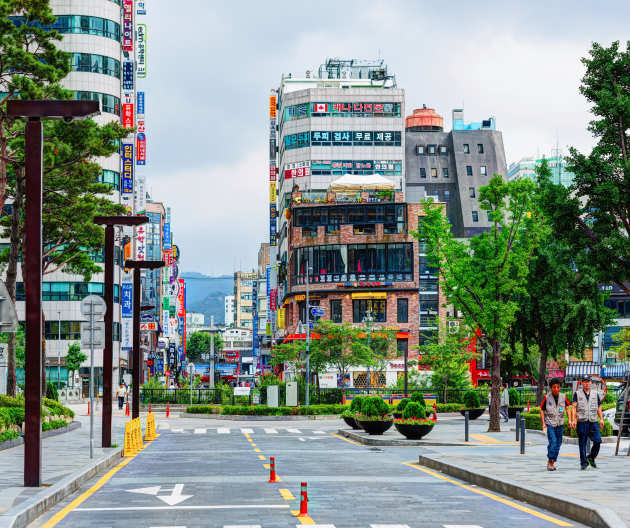
This module is intended for those who have already acquired a basic knowledge of Korean alphabet (Hangul) and are able to carry out elementary communicative tasks in Korean. The module starts with a thorough revision of the basic Korean structures that you have learnt in Level 1, after which new structures are introduced. The module offers students the chance to achieve a higher level of communication skills in Korean through the assimilation of more complex grammatical structures and a wider range of speech patterns. Further aspects of Korean history and culture will also be introduced.
Basic linguistic structures to include:
- Revision of structures covered in Level 1
- The noun-modifying form (adjective,verb)
- The honorific particles and expressions
- Clausal connectives (reasons, causes, sequential)
- The progressive form or continuing action
- Obligation or necessity
- The negative form
- Present perfect form
- The adverb-modifying form (adjective, verb)
- Negative commands or requests
Topics:
- Birthday and Korean age counting
- Professional life and career
- Daily routine, timetable
- Accommodation
- Feelings and emotions
- Telephone conversations
- Health and body
- Transport, travelling, and Weather
- Written correspondence (postcards, letters)
- Notions of Korean culture, history and traditions
- Revision and consolidation of topics from the previous level
Assessment
- Coursework 40% - 4 pieces of coursework (in the form of in-class tests including listening comprehension execises)
- Written examination 35% - Two-hour written examination at the end of the Spring term
- Oral examination 25% - A 15-minute oral examination at the end of the module
Key information
- 7.5 ECTS points awarded on successful completion of the module.
- Available to take for credit towards your degree where your department allows. Also available for extra-credit.
- You must be prepared to attend all classes and undertake approximately 3 hours of private study each week in addition to the assessment.
Module Materials:
Cho, Y. et al (2010). Integrated Korean Textbook; Beginning 2 (2nd ed.), University of Hawai’i Press, US. ISBN: 978-0-8248-3515-6
Park, M. et al (2010). Integrated Korean Workbook; Beginning 2 (2nd ed.), University of Hawai’i Press, US. ISBN: 978-0-8248-3516-3
The course is supported by additional materials